
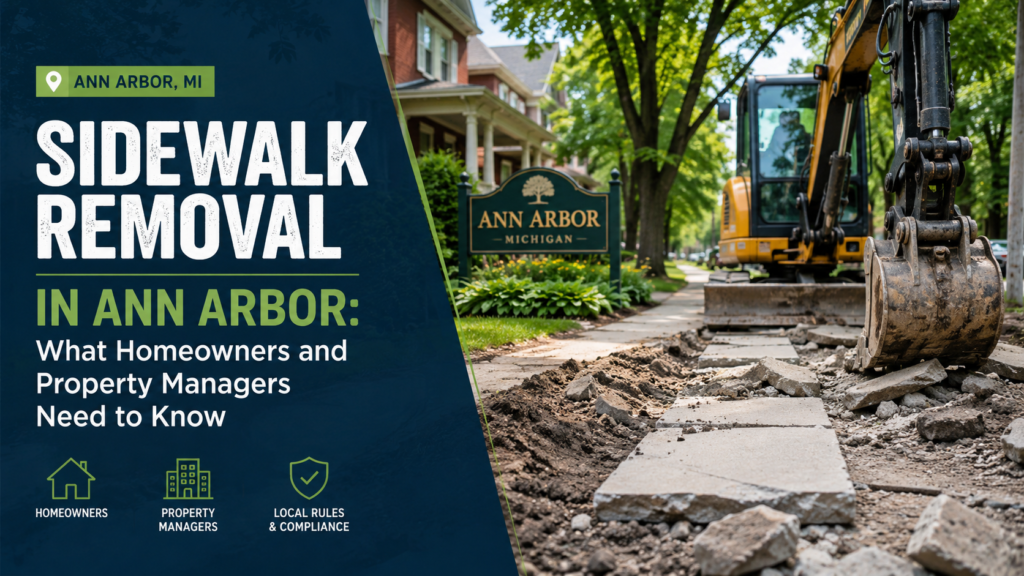
Sidewalks are an essential component of Ann Arbor’s walkable, pedestrian-friendly neighborhoods. But like all concrete infrastructure, sidewalks age, deteriorate, and eventually need to be replaced. Sidewalk Removal Ann Arbor property owners face is a project that requires understanding both the technical aspects of concrete removal and the regulatory context that governs sidewalk maintenance in the city.
This guide covers everything homeowners and property managers in Ann Arbor need to know about sidewalk removal from recognizing when removal and replacement is needed to understanding the repair program the city administers and how professional contractors perform the work.
Ann Arbor’s Sidewalk Repair Program
Ann Arbor operates one of the most organized sidewalk maintenance programs in Michigan, funded by a millage that voters first approved in 2011 and have since renewed. The Sidewalk Repair Program works on a five-year cycle, addressing sidewalks throughout different areas of the city on a rotating basis.
Within this program, the city contracts with three types of repair approaches:
- Remove and replace: Full removal of deteriorated concrete slabs and installation of new concrete. This is appropriate for slabs with significant cracking, settlement, or structural failure
- Horizontal cutting: Grinding down vertical displacement at slab joints to eliminate trip hazards without full slab removal. Appropriate for slabs that have settled unevenly but are otherwise sound
- Mudjacking: Injecting grout beneath sunken slabs to lift them back to grade. Appropriate for slabs that have settled but are not cracked or deteriorated
Prior to the 2011 millage, property owners adjoining public sidewalks in Ann Arbor were responsible for repairs themselves. The current program has significantly improved the condition of the city’s sidewalk network while relieving individual property owners of the direct financial burden for public sidewalk repair.
People Also Ask: Sidewalk Removal Questions in Ann Arbor
When Is Sidewalk Removal and Replacement Necessary?
Not every sidewalk problem requires full removal and replacement. Understanding when removal is the appropriate solution helps property owners and managers make informed decisions:
- Significant cracking: When a sidewalk slab has multiple through-cracks, especially if the edges are differentially settled (one piece higher than adjacent pieces), repair patching is generally not durable and replacement is more cost-effective
- Frost heave: Michigan’s freeze-thaw cycles can cause soil beneath sidewalk slabs to heave, lifting and cracking the concrete. Once heaving has occurred and the slab is broken, replacement is typically the best approach
- Root damage: When tree roots have grown beneath and lifted sidewalk slabs, the roots must be managed (cut or redirected) and the affected slabs removed and replaced. Installing root barriers during replacement helps prevent recurrence
- Settlement over utilities: Sidewalk slabs that have settled over utility trenches or other underground disturbance often need removal and replacement, sometimes with investigation of the underlying cause
- ADA non-compliance: Older sidewalk sections that have not been maintained may not meet current ADA standards for slope, width, or surface condition, necessitating removal and reconstruction to current standards
What Is the Process for Professional Sidewalk Removal?
Professional sidewalk removal in Ann Arbor follows a defined sequence that ensures safety, efficiency, and quality:
- Utility marking: Before any excavation or removal, underground utilities must be located and marked. Miss Dig (Michigan’s one-call utility locating service) must be notified at least three working days before digging begins
- Sawcutting: Concrete saw cutting creates clean, straight cuts at the boundaries of the sections to be removed, preventing damage to adjacent slabs that will remain in place
- Breaking: Jackhammers, pneumatic breakers, or small excavators with breaker attachments break the concrete into manageable pieces
- Removal and loading: Concrete pieces are loaded into dump trucks for transport to concrete recycling facilities
- Sub-base preparation: The area beneath the removed slabs is inspected, compacted, and if necessary, regraded or supplemented with new aggregate base material
- New concrete placement: New concrete is placed and finished to appropriate slope, thickness, and surface texture
- Curing: Concrete must cure for an appropriate period before foot traffic is allowed
What Happens to Removed Concrete?
Concrete removed from sidewalk projects in Ann Arbor is almost universally recycled rather than landfilled. Recycled concrete aggregate (RCA) is produced by crushing removed concrete into various size gradients that can be used as:
- Base material beneath new pavement (asphalt or concrete)
- Drainage aggregate
- Fill material for construction projects
- Road base on unpaved roads and access routes
The concrete recycling industry in Michigan is well-developed, and Ann Arbor’s proximity to Detroit-area recycling facilities means that virtually all removed sidewalk concrete is productively repurposed. This makes sidewalk removal and replacement a relatively sustainable process from a materials lifecycle standpoint.
What ADA Requirements Apply to Sidewalk Replacement in Ann Arbor?
Ann Arbor has committed to bringing all public sidewalks and curb ramps into compliance with the Americans with Disabilities Act. For any sidewalk replacement project, current ADA standards require:
- A maximum cross-slope of 2% (which is barely perceptible to most pedestrians but critical for wheelchair users)
- A maximum running slope that matches the adjacent grade, with specific limits at accessible routes
- Detectable warning surfaces (truncated dome patterns) at curb ramps
- Minimum clear width of 60 inches for shared-use paths and specific requirements for narrower sidewalks
Property owners or managers undertaking private sidewalk replacement should be aware of these standards, particularly if the sidewalk is adjacent to a public right-of-way or serves a public-facing commercial property.
Private Sidewalks Versus Public Sidewalks: Who Is Responsible?
A common source of confusion for property owners in Ann Arbor is understanding which sidewalks are the city’s responsibility and which are private:
- Public sidewalks: Sidewalks within the public right-of-way (typically the strip of land between the property line and the curb) are public infrastructure. Under the current millage-funded program, the city is responsible for their repair and maintenance
- Private sidewalks: Walkways on private property from a public sidewalk to a building entrance, through a private parking lot, or connecting structures within a private campus are the property owner’s responsibility for maintenance and replacement
- ADA transition plans: Commercial and public-accommodation properties have specific obligations under the ADA to maintain accessible routes, regardless of whether the path crosses both public and private sidewalk sections
Understanding this distinction helps Ann Arbor property owners know when to coordinate with the city’s Sidewalk Repair Program and when to engage a private excavating and concrete contractor for sidewalk removal and replacement on their own property.
Why Professional Sidewalk Removal Matters
Sidewalk removal may seem straightforward, but there are good reasons to engage professional contractors for Ann Arbor projects:
- Underground utility protection: Without proper utility marking and experienced excavation technique, underground gas, water, electrical, and telecom lines are at risk of damage a potentially dangerous and costly mistake
- Adjacent slab protection: Improper removal technique can crack adjacent sidewalk sections that were intended to remain, creating a larger replacement scope
- Sub-base quality: The condition of the sub-base beneath removed sidewalk sections directly affects how long the replacement concrete will last. Professionals assess and address sub-base conditions that are not visible until the old concrete is removed
- Regulatory compliance: Ann Arbor has specific requirements for work within the right-of-way, including permits and inspections, that professional contractors navigate routinely
For private sidewalk projects in Ann Arbor whether a residential property walkway replacement or a commercial facility upgrade engaging an experienced excavating contractor ensures that the removal and replacement process proceeds safely, efficiently, and in compliance with all applicable requirements.